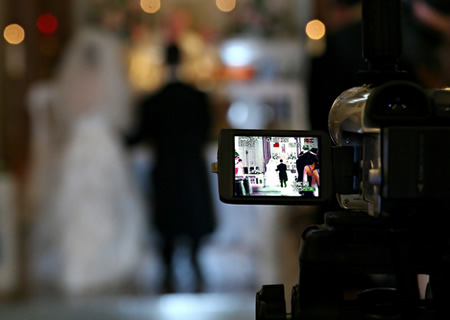
Can't a friend or family member videotape my wedding?
Yes, but don't expect professional results. Most friends and
relatives don't have the training, experience or the equipment
of a professional videographer. Camera technique is more involved
than knowing how to point and shoot. A wedding can't be re- staged
for the camera if sound on the tape is inaudible, a battery runs
out of power, or the videographer hasn't planned his camera placement
and misses key parts of the ceremony. A professional videographer
offers digital mastering, titling, special effects, editing equipment,
professional microphones, tripods, lighting and sufficient back-up
equipment to produce a high quality production.
Also, keep in mind that a friend or family member who is intent
upon recording your wedding day cannot enjoy this occasion as
a guest...he is too busy working for you. And if the video does
not meet your expectations will you feel comfortable expressing
your disappointment? Will your displeasure affect your relationship?
Is there much difference between video services? Why shouldn't
I necessarily choose the company with the lowest price? You
should be aware that many people in the business of videotaping
weddings are amateurs. As with relatives or friends, such well-meaning
individuals often do not have the technical background, experience
or equipment to do the job well. Professional videographers work
under very challenging conditions. By the very nature of a wedding
they cannot control the lighting, the composition or physical
positions of the participants. They are literally at the mercy
of their environment and only through experience do they know
how to adapt to variable situations and still capture the emotions
and facial expressions that an amateur might miss. The individual
you hire should also be skilled at working with people: you, your
family, the wedding party, the presiding official and your photographer.
How do I find the right wedding videographer?
It's a fact of life that price plays a key role in determining
your selection of vendors. Once you determine your spending limit,
then you can begin to appraise videographers in the four areas
that differentiate them: equipment, experience, style and individual
personality. Equipment and experience must meet a certain minimum
level before you can evaluate style.
Most professionals now use digital cameras and digital editing
equipment. But the equipment doesn't do all the work. That's where
video experience, and more specifically, wedding video experience
comes into play. Wedding experience means how long the videographer
has been shooting weddings and how many he has done.
When looking for a professional videography service, we suggest
you personally meet with three videographers and view their demo
tapes and parts of a full-length video they have made for a client.
Decide if your personalities mesh and you feel comfortable working
with this person...you are going to be spending most of your wedding
day with him/her. Assure yourself they offer professional quality
and value. Is the camera held steady? Is the edit smooth from
one sequence to the next? How well is the emotion of the day reflected
in the video? Is the audio quality good? How clearly can you hear
the vows? Realize that producing a wedding video is a creative
process...each professional videographer has his own style and
you must decide which style best meets your expectations. When
viewing a videographer's work, you will become aware of the many
subjective intangibles that come together to create a videographer's
unique style. You will instinctively know when a particular videographer's
artistic genre clicks with your own
How much should I expect to pay for a professional video? On
average, the cost of a professional wedding videographer is 10
percent of your total wedding budget. That is a small fraction
of the cost of your reception! Yet with the exception of your
photos, your video is all you have after your wedding day...it
is the ultimate permanent record of this memorable event. Fees
are determined by the experience of the videographer, technical/professional
level of equipment, number of cameras, length of time at your
event and the selection of additional premium services (elaborate
photo montages, personalized endings, etc). Let your overall wedding
budget and the amount set aside for photos be your guide. Quality
video requires an investment equal to quality photography.
Is it necessary to sign a contract/agreement with my wedding
videographer? Yes! Hiring a wedding videographer is a business
arrangement and it is essential to sign a contract. This contract/agreement
should delineate:
The services selected
The cost of services
The schedule of payments
Any special requests
Expected time of delivery
Will the video equipment be distracting during the ceremony? Because modern video equipment is compact, portable and silent,
the most important consideration is whether or not the videographer
has the skill to avoid intruding on the ceremony. The camera should
remain stationary on its tripod. He should be sensitive to your
needs, the requirements of the church and officiant. He should
do his best to stay out of the way, yet cover all-important events.
I want to be sure to hear our vows on the video. Will this
be possible? If the ceremony was to be recorded using the
camera's built-in microphone, your vows would most likely be inaudible
. . . these microphones lose clarity at distances beyond 7-10
feet. A knowledgeable videographer will utilize professional wireless
and wired microphones, generally worn by the groom and minister
and/or placed near musicians and readers.
Should I consider multiple camera coverage for my ceremony
and reception? Yes, if your budget permits . . . it is worth
the expense. A two (or more) camera production gives different
views of the same event or allows each videographer to capture
different activities that may be occurring simultaneously to create
a more interesting video. Good editing integrates the camera footage
together . . . selecting the best views from each camera . . .
to make your wedding story more dramatic and compelling.
Where are multiple cameras placed at the ceremony? One
possible camera placement is on the groom's side of the altar,
slightly behind the officiant performing the ceremony. This position
usually can get good close- ups of the bride during the vows and
ring exchange. Another good location is a second floor loft or
balcony overlooking the altar area and giving an overview of the
entire church . . . or placed at the back of the center aisle
to provide a wide angle overview of the ceremony as seen by your
guests. A third camera could be situated on the bride's side of
the altar to provide close-up shots of the groom. Camera placement
outdoors or in a hotel will depend on the physical layout of the
particular venue.
If my ceremony or reception location is dimly lit, how will
my video look? Lighting will determine the quality of your
video. Most churches have sufficient lighting to produce acceptable
video. For best results the lighting should be balanced and uniform.
While experienced wedding videographers usually have professional
grade, low light digital cameras, it is wise to make maximum use
of the interior lighting to ensure the best quality recording.
Although ceremony lighting is often selected to create the appropriate
atmosphere or mood, you will want to consider how a low light
ceremony will affect your video and then decide on the best light
level for your personal needs and priorities.
If the house lights are insufficient, your videographer should
light your reception events with a low-wattage, on-camera light.
This compromise solution allows him to provide adequate lighting,
yet remain unobtrusive.
Should I expect my videographer to attend my rehearsal? Whenever
possible, your videographer should attend your rehearsal. This
enables him to avoid unpleasant surprises, such as having attendants,
candles and flowers blocking the camera's view during the vows
and ring exchange. His familiarity with your ceremony location
does not necessarily ensure proper placement of cameras and microphones
for your particular wedding ceremony. This is also an opportunity
for the videographer to meet with the officiant to discuss any
concerns each may have as well as meet the wedding party and members
of the wedding families.
How much video is actually recorded and what is the average
length of a wedding video? About 4-6 hours of raw, unedited
footage is typically recorded for a two-camera ceremony/reception.
Ceremony only coverage would be in the 2-3 hour range. A tightly
edited video of the ceremony and reception runs anywhere from
one to two hours depending on the length of the ceremony and the
amount of time you have hired the videographer to cover your reception.
Professional videographers shoot a lot of footage to make certain
they capture all the special moments and then use their post-production
editing capabilities to condense the raw footage, adding music,
titles, and special effects. Post production is the most time
consuming part of their job...much more so than the time they
spend recording your wedding day. It is not unusual for a videographer
to spend 30 to 40 hours to create your wedding heirloom.
Is editing necessary since I want to see everything that was
recorded? Editing typically means combining the best footage
from all cameras to produce an unparalleled memory of your day.
It eliminates unnecessary duplication that is boring and involves
the addition of titles, music, still photos and special effects
(fades, dissolves, etc.). Editing is used creatively, to give
your wedding production better pacing and capture the natural
beauty and personality of your event.
What kind of coverage does the 'typical' wedding video include? A wedding video usually begins with introductory titles. This
may be followed by exterior and interior views of your wedding
location. The more elaborate video packages contain pre-ceremony
coverage to include part of your photo session (with the permission
of your photographer) and last minute preparations before you
actually go down the aisle. Next, the entire ceremony is recorded
from the processional to recessional and everything in between.
Post ceremony footage may show you signing your wedding license
and/or departing in your limo.
Should you select ceremony/reception coverage, your videographer
will continue to your reception location and tape the customary
activities: your introduction into the reception, first dance,
toasts, cake cutting, father/daughter dance, bouquet and garter
toss; and ...at your request... personal messages from guests.
Other popular, premium services which increase editing time and
add to the cost of your video are: pre-ceremony coverage at bride's
home, photo montages, love stories, highlight montages, the short-form
wedding edit, Hollywood style movie credit presentation of your
wedding party, a personalized ending and your wedding video on
DVDs.
What about the restrictive policies some churches have? Most
professional videographers respect and abide by the existing rules
of a church or ceremony venue. While they can readily provide
you with professional expertise to explain your video concerns
to the church coordinator, it is the client's responsibility to
request any changes to these policies. If the restrictions are
too rigid and limiting you may want to consider searching out
another wedding location.
What will happen if my videographer is ill, injured or has
some family emergency? This is a potential problem for any
date/time specific event. If you have selected a wedding videographer
who belongs to professional associations and networks with other
local videographers, it is likely a back-up arrangement can resolve
this risk. Most professionals limit their liability to returning
money paid by the client in the event of non- performance and
state this in their contract with you.
Should I provide a meal for the video crew at my reception? It is a welcome courtesy if you provide a meal for your videographers.
Wedding videography is a physically demanding job...and the workday
can often start early, and last well into the night. Proper nourishment
is critical to quality work. It need not be a full-course meal
but something that can be provided quickly so that they are ready
to work again at a moments notice. Many reception venues include
the option for you to purchase vendor meals. It's also thoughtful
to ask your caterer to set up a small table in the corner of the
reception room or a side room for your vendors to eat. Normally
your wedding service providers eat their meals while the guests
eat.
How can I assure that my videographer will perform his best
work for me? Excellent video doesn't happen by chance. Assuming
a videographer can work around bridal party obstructions, poor
lighting, and severely restricted camera placement, will put the
quality of your video at risk. Let him know all the details of
your event...provide him with a written schedule, when possible.
Your cooperation to overcome foreseeable problems is vital to
receiving a quality video. A final planning session with your
videographer, usually within two weeks of your ceremony, to discuss
these details is advantageous for all concerned. Other considerations
are also important:
Inform your officiant that you intend to have your ceremony
videotaped. Discuss your wishes concerning video during the initial
meeting with church/ceremony personnel to clarify existing policy.
You need to be aware of any restrictions and video guidelines.
Furnish all information needed to complete your wedding
video on time.
Consider providing a light meal when your videographer
is working for you five hours or more.
If parking is at a premium, designate a parking space
for your videographer ... time searching for a parking place is
time away from working for you.
Make your payments on time as defined in your contract.
How long should it take to get my finished video after the
wedding? This usually depends on the time of year and your
timeliness in delivering needed materials to complete the video.
Weddings tend to be seasonal. Most occur on weekends from May
through October...the warmer months in many areas of the country.
Videos that are developed and refined in post production can take
from one to six months after the event to complete. The more lengthy
production time is due to the combination of seasonal workload
and the labor-intensive editing process.
Article Courtesy of:
A Pinetree Video Production
|